What Most Plastic Processors Won’t Admit
Let’s be clear.
Screw barrels do not “suddenly go bad.”
They are misapplied.
They are under-specified.
They are bought based on price.
And then they get blamed.
In most factories, the screw barrel stays hidden from attention until production numbers drop, pressure begins fluctuating, or scrap quietly increases. That’s when maintenance steps in. The barrel is removed. A replacement is installed.
Same size. Same specification. Maybe a little cheaper.
And the cycle begins again.
If you are searching for a screw barrel manufacturer in India, pause for a moment.
The real problem may not be supply. It may be a selection.
Stop Matching Dimensions. Start Matching Conditions.
Too many purchasing conversations begin like this:
“What’s the diameter?”
“What’s the L/D?”
“What’s the price?”
That’s the wrong order.
The first question should be:
“What is this machine actually processing every single day?”
Virgin PP at a moderate production rate? Fine. That’s predictable.
Thirty percent glass-filled nylon running two shifts nonstop? That’s abrasion. That’s heat stress. That’s internal punishment.
Recycled blends? Mineral fillers? High shear rates?
Every one of those variables directly impacts how long your barrel survives — and how it fails.
If your supplier isn’t asking detailed questions about material, throughput, temperature, and operating hours, you are not getting engineering advice.
You’re getting inventory.
Geometry Is Not Decoration
Compression ratio.
Flight depth.
Mixing section.
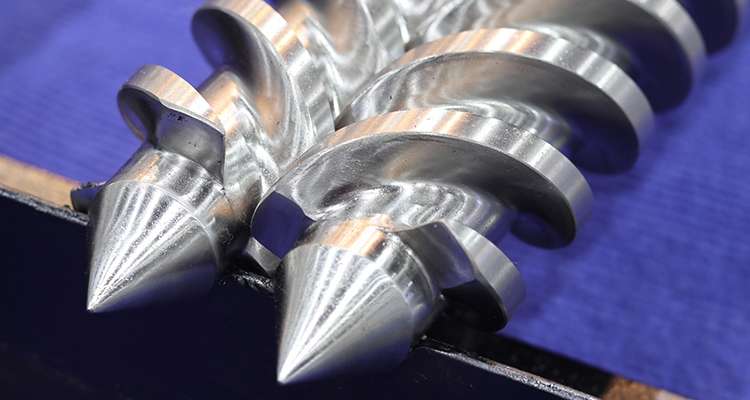
These are not optional upgrades. They directly influence melt behaviour.
Get the geometry right, and you’ll see it in:
- Stable pressure
- Better dispersion
- Uniform surface finish
- Improved energy efficiency
Most general-purpose screws are designed to “function.” They are not designed to optimise.
If your machine is capable of more but isn’t delivering it, the problem may not be the machine.
It could be the screw.
Price Is Not Cost
Let’s speak honestly about metallurgy.
Standard nitrided barrels are common. They are affordable. They are suitable for the right application.
But place that same barrel into a high-abrasion environment, and you’re simply counting down months.
Procurement celebrates the lower purchase price.
Maintenance absorbs the actual cost.
Bimetallic barrels are more expensive upfront. That is obvious.
What is less obvious:
- The cost of downtime
- The cost of scrap
- The cost of unstable production
- The cost of frequent replacements
If you are evaluating a screw barrel manufacturer in India, ask this:
“What will this barrel look like after 12 months in my exact operating conditions?”
If the answer is vague, that’s your signal.
Structured manufacturing discipline is not marketing language; it is process control. You can explore how this works in practice in our detailed breakdown of the process followed by a screw barrel manufacturer in India, covering material selection, machining, heat treatment, and quality checks.
Process discipline shows up in product durability.
A Real Scenario and Not a Marketing Story
A moulding plant processing 30% glass-filled polypropylene was replacing barrels roughly every nine months.
Each time, the same specification was purchased. Lowest bidder.
Pressure instability became routine. Scrap gradually increased. Maintenance interruptions became normal.
After the technical evaluation, the conclusion was simple:
The barrel material was not suitable for the level of abrasion.
Switching to a bimetallic barrel and refining screw geometry extended operational life to well beyond 18 months.
No machine replacement.
No dramatic overhaul.
No miracle.
Just alignment between metallurgy and material.
That’s it.
Hardness Numbers Don’t Mean What You Think
HRC values look impressive on paper.
But hardness without application alignment is meaningless.
Gas nitriding. Plasma nitriding. Alloy linings. They all have value.
But corrosive polymers don’t care how hard your barrel is if the chemistry isn’t protected.
Ask for:
- Hardened layer depth
- Treatment consistency
- Real-world performance data
If all you receive is a specification sheet, ask more questions.
Maintenance Is Not Optional — It’s Strategic
Even the best barrel fails early under poor operating practices.
Dry runs. Improper shutdowns. Irregular cleaning. Ignored wear patterns.
And then the barrel gets blamed again.
Maintenance is not a support function. It is a performance variable. In our article on maintenance strategies for extending screw and barrel life, we break down cleaning cycles, shutdown protocols, and wear monitoring practices that make measurable differences on the shop floor.
Engineering and maintenance are partners and not substitutes.
If Your Supplier Only Sends Quotations, That’s a Warning
Here’s the uncomfortable truth.
A serious screw barrel supplier in India should challenge your assumptions.
They should ask:
- What are you processing?
- How many hours are you running daily?
- What wear patterns are visible?
- What is your scrap trend over time?
If the conversation is only about pricing and delivery time, you are not being supported.
You are being processed.
Final Reality
In plastic processing, inefficiency does not shout.
It whispers.
It shows up as slight pressure variations.
Small scrap increases.
Slow wear.
Frequent “routine” replacements.
And over time, it becomes expensive.
Your screw barrel is not just a component inside a machine. It is a decision repeated every cycle, every hour, every day.
Choose based on engineering, not habit.
If you are evaluating a screw barrel manufacturer in India, choose one that asks difficult questions before giving easy answers.
That’s usually where performance begins.